Rudy Versus Maria, A Quick Guide!
I read a bunch of "Comparing Montessori to Waldorf" articles and they literally all sucked.
A few years back, I was in fact looking into preschools, and read some articles with names like “What’s the Difference Between Waldorf and Montessori?” I came away from those articles with the idea that they were both good in different ways and we’d be happy to end up in either (we didn’t end up in either, weirdly enough).
During my latest round of research, I came across some of the same articles all over again, as well as more recent ones based on the same premise. I was desperately digging for some idea of what Montessori and Steiner, these two big European thinkers who were working during at least some of the same times, thought of each other! I didn’t find that. But I did find a whole lot of these short explainer pieces. And let me tell you something, they’re all terrible.
First of all, they are almost exclusively focused on preschool or early childhood education and helping parents (with money) choose between the two. That means if you want information about how these approaches handle, say, seven year-olds, you are out of luck. Second of all, they are all focused on the surface level: both have a lot of wooden things! Waldorf does more fairy tales! Montessori has them pour water! There is next to no information about the ideas behind these philosophies.
So, I decided to write my own. Without further ado, I will now compare Waldorf and Montessori on seven key issues.
1. Religion and Spirituality
Maria was a catholic, and believed that spiritual development was important for children, and many of the more dogmatic Montessori adherents take this very seriously. That said, it is only one part of her larger ideas, and often gets very watered down in the classroom. In her first classroom, the Casa de Bambini, she put up a picture of the “virgin and child” which was meant to inspire the children’s souls to greatness, even if they did not consciously understand it. Many modern Montessori schools look and feel quite secular, however.
Maria did believe that teachers needed to spiritually prepare for educating children.
Rudy created his own little religion (sorry! spiritual science) called anthroposophy, and his ideas about spirituality and how children develop spiritually were incredibly specific, and underpin basically everything that is done in a Waldorf school. Lessons on specific topics are brought when Steiner believed children would be spiritually ready for them. While anthroposophy is not directly taught to children, it impacts every part of their education, and they may even be taught specific prayers that Waldorf teachers refer to as “verses” to make them less controversial. Bible stories are taught as an introduction to history, and while many a Waldorf teacher claims these are taught in a secular way, I have also read that they are specifically taught to encourage the child to develop an inner voice based on the old testament god.
Teachers are required to study Steiner’s works, meditate, and pray for their students. For homeschoolers, this is often much looser.
2. Origins of Ideas
Maria was a successful doctor who ended up working with disabled children, and then became interested in education. She came to many of her ideas through observation of both disabled and more typically abled children, including a great deal of experimentation at the first school she ran, the Casa de Bambini. Some of her concepts were also based on those of earlier educators.
Rudy was an occultist who had some kind of spiritual awakening and believed that he had studied the “akashic records” a kind of mystical psychic library of all human knowledge. He had no direct experience with children or education, and only assisted with opening a school based on his ideas because his buddy, the owner of the Waldorf Cigarette Factory, invited him to.
3. Self determination and Child Led Learning
Maria believed children should have freedom. As such, Montessori schools are set up with a carefully prepared environment meant to encourage “auto education.” That said, this is freedom under some very specific constraints and many advocates of self directed learning have complaints about Montessori not going far enough. I’ve also heard that the constant choice is overwhelming for some children.
Rudy believed children needed free play time, but also that specific academic lessons needed to be brought at specific points of childhood development. As such, preschool includes a lot of free play time, and even older children do often get longer recesses than at public schools, but education is never child led as the curriculum is very specific about what should be learned at what age.
4. Fairy Tales and Make Believe
Maria found that children in the Casa de Bambini seemed far more interested in learning about the real world than such things, and this reinforced her idea that the real world, and real skills, are richer and more interesting than make believe. Not only that, she felt strongly that teaching fairy tales to children was often more about making adults comfortable than delighting the child, and that they had no place in education. This has led to the idea that pretend play is not “allowed” in Montessori schools, but I’ve also been told that this isn’t really the case. It just isn’t part of the curriculum.
Rudy believed that children learned best through stories, and that in early childhood, the best stories were (European) fairy tales. He believed that the archetypal characters in this stories would be instinctively relatable for children, and that the fanciful stories would speak directly to children’s souls. As such, there is a great deal of emphasis on stories and fairy tales in Waldorf schools, and images of dragons, gnomes, and fairies abound in the earlier grades.
5. Art
I haven’t found much about art specifically in Maria’s writing, but it is my understanding that art is approached in much the same way as everything else in the Montessori classroom. That is, some form of artistic expression is available as one of the many options that children can explore in the prepared environment. Art tends towards “process art,” meaning the experience of making it is considered more important than the final product.
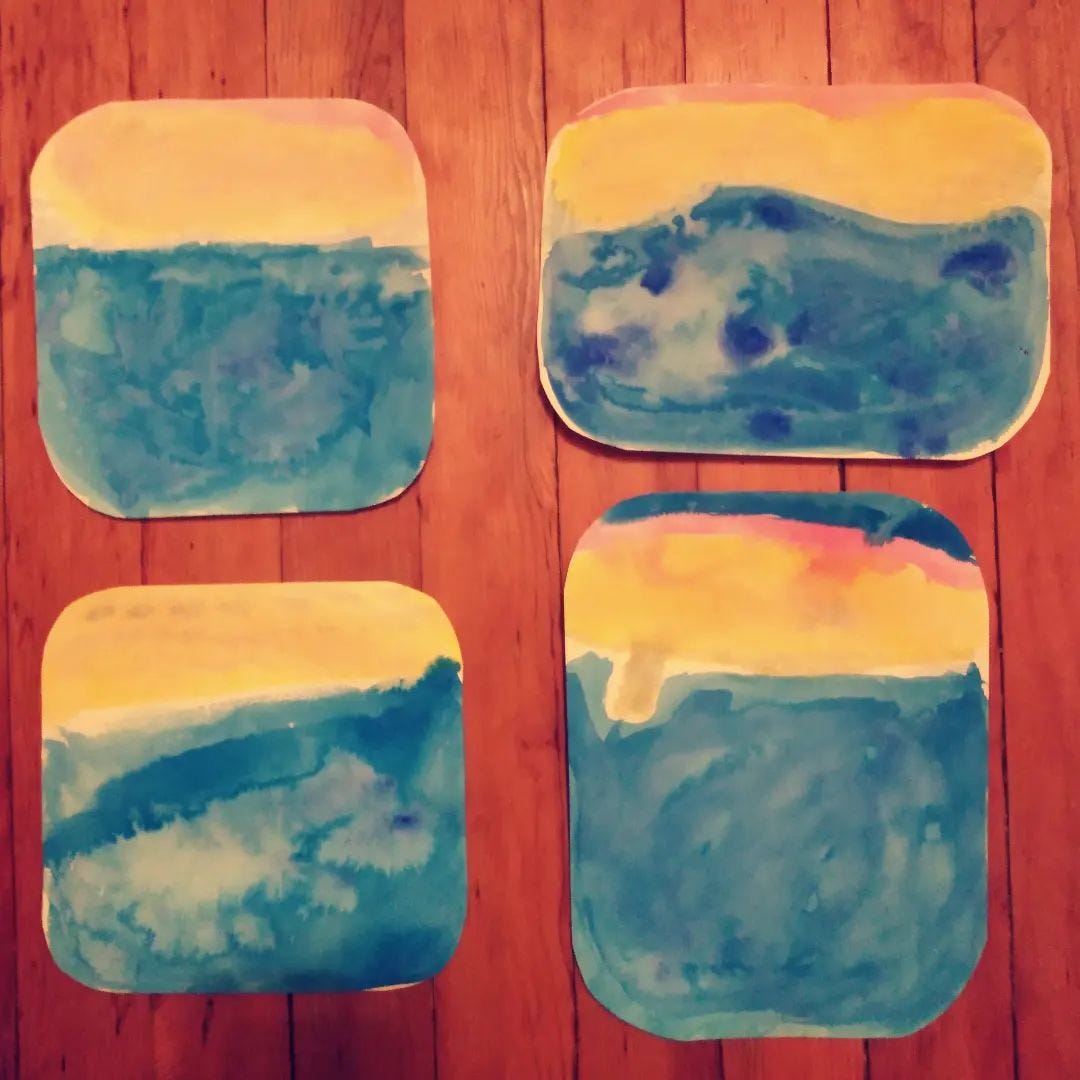
Rudy believed the arts were vital to connecting to children’s souls, and as such art is a huge part of Waldorf education, and one that draws many parents (including myself!) in. Drawing, painting, and modeling are explicitly taught, but in a specifically “Waldorf” style that is unlike what you will see in nearly any other art classroom. These lessons are also often very top down once children are in “the grades” and are more about following instructions and practicing a specific technique than they are creative expression.
6. Literacy, Reading, and Writing
Maria was a proponent of phonics education. She gave children moveable alphabets and taught them the sounds of the letters, and found that over time even very young children began to teach themselves how to write, and then read. Montessori education still relies heavily on auto education for reading, and while the phonics component makes it a better reading education than some others, it should also be noted that Maria’s pupils were learning to read and write in Italian, a much simpler phonetic language than English.
Rudy essentially asked teachers to create their own reading curriculum, and the standard idea in Waldorf schools has been to teach the alphabet in first grade (and not before!) through fairy tales and stories. After that point, students learn to read through writing in their main lesson books with the guidance of their teachers. This apparently works decently in German, which is also a very phonetic language, but isn’t ideal in English. Because teachers are asked to make their own curriculums, different ideas about reading and writing can take hold in different classrooms, and whole word and whole language ideas often have held sway. Additionally, this can be further confused by teachers thinking they should teach the German sounds for vowels because Rudy wrote some things about their spiritual significance. In more recent years, thankfully, there has been a move to include science of reading principles in the Waldorf classroom (I am currently reading The Roadmap to Literacy and I promise to write about it a bunch when I’m done).
7. Desks
Maria hated desks with a passion and compared them to slavery. Montessori classrooms don’t have them.
Rudy was neutral on desks. Many Waldorf classrooms utilize desks, while others use tables.